
How to Practice Tennis alone Without a Court.
There are five things you may work on to practice tennis by yourself without a court: ball feel, stroke technique, footwork, fitness and focus. You can conduct shadow swings, serve throw training, ball control drills, split-step and agility work and wall hitting if you can find a flat surface in a driveway, garage, corridor, backyard or park. None of these requires a net, partner or booked court.
This guide is for recreational players, youngsters, tennis parents and coaches looking for an organized strategy to train between court sessions. It has a full drill library built on a simple approach, a 30-minute practice plan, a weekly calendar and a clear idea of what solo training can and can’t do.
Key Takeaways
- No court needed to learn actual tennis skill. Technique, footwork, ball feel and conditioning may all be learned at home, and translate directly to match play.
- The finest substitute for a striking partner is a wall. Any flat surface with no windows, a garage door, wall of a gym or school building.
- Power does not dominate every individual drill. Hitting softer means longer rallies, more reps and faster growth.
- Time is less important than structure. A 30-minute focused workout on feel, form and feet is better than an hour of mindless striking.
- Solo practice has its limits. It cannot mimic the unpredictability of an opponent thus use it in conjunction with real match play whenever possible.
Can you really get better at tennis without a court?
Yes. Much of the difference between consistent players and inconsistent players is coachable off the court: clean stroke mechanics, early preparation, solid footwork, a repetitive serve toss and overall agility.
Think carefully what really happens during a point. Before your racket even hits the ball, you have split-stepped, read the impending stroke, gotten into position, set your stance and started your swing. You can practice each of these steps right in front of you without a net.
There’s one honest disclaimer. Solo training does not recreate the unpredictability of a real opponent nor the tactical aspects of match play. Still you will need actual rallies and matches to develop shot selection and strategy. Don’t look to no-court practice as an alternative to court time, but as a tool to make your court time significantly more productive.
What Equipment Do You Need to Play Tennis Without a Tennis Court?
At the very least: a racquet, a few tennis balls and a small flat space. All the rest is optional. 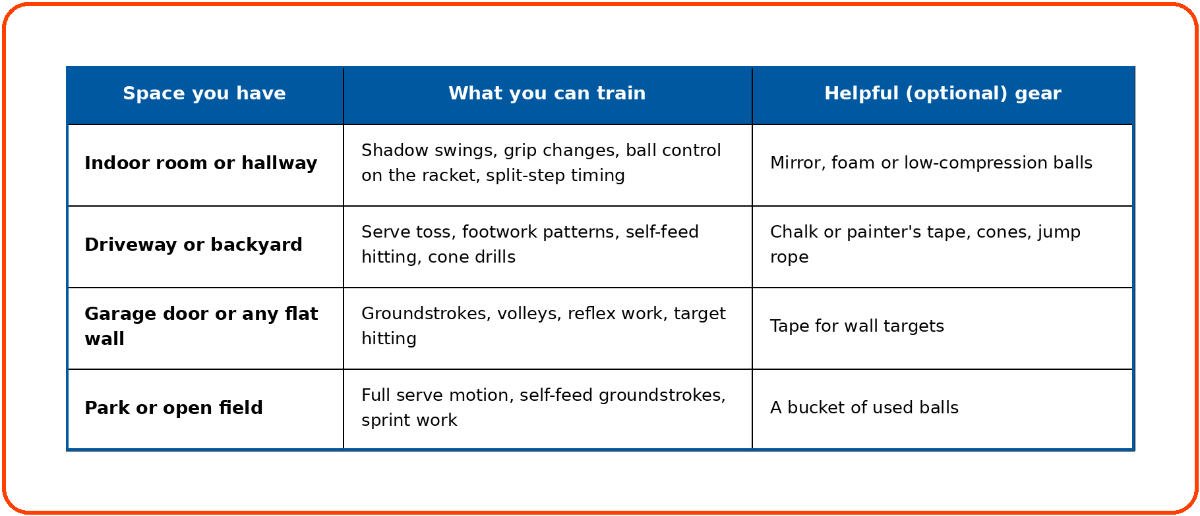
Two practical notes. First, painter's tape works well indoors because it removes easily, and sidewalk chalk works outside for marking service boxes, baselines or mini-courts. Second, if you hit against a building choose a solid wall with no windows. Obvious, but it is the number one way solo practice sessions end early.
The 5F No-Court Training System.
Instead than working through a random set of drills, make each session revolve around five areas. Each one emphasises a different aspect of your game and collectively they cover practically everything you can work on without a court.
- Feel: hand-eye coordination and ball control
- Form: stroke and serve technique
- Feet: footwork, split step and recovery movement
- Fitness: tennis-specific conditioning
- Focus: video review, visualization and tracking
A good solo session touches at least three of the five. The sections below give you the drills for each.
Feel: Ball Control Drills You Can Do Anywhere
Ball feel is the quiet skill behind every clean shot, and it needs almost no space.
- Racket bounces (downs): Dribble the ball on the ground with your strings, like a basketball. Aim for 50 in a row.
- Racket bounces (ups): Bounce the ball upward off your strings. Progress to alternating string sides on each touch, then to bouncing on the racket's edge for an advanced challenge. 1 Racket dribbling builds hand-eye coordination and doubles as a confidence skill.
- Self-toss and catch: Toss the ball up, let it bounce, and catch it on your strings without it rolling off. This trains the soft hands you need for drop shots and volleys.
- Pickup without hands: Learn to lift a ball off the ground using only your racket and foot. Small skill, real dexterity gains.
Turn these into games. Count your record, then try to beat it next session. Turning practice into a game adds motivation and builds skills that carry into competitive play.
Form: Shadow Swings and Serve Technique at Home
Shadow swinging means performing your full stroke without a ball. It sounds basic. Done deliberately, it is one of the highest-value drills in tennis because nothing interrupts your technique.
Mirror shadow swings. Practice groundstrokes, volleys and your serve motion in front of a mirror with space for a complete swing. Slow the swing down and you may assess your wrist and arm position, foot position, hip and shoulder rotation and transfer of weight. Ten excellent patient forehands are better teachers than fifty hasty ones.
Full-pattern shadow strokes. Do not just swing. Start in the ready position, split step, move to an imaginary ball, set up, swing and recover. That recovery step is the part most players skip, and it is exactly what breaks down in matches.
Practice serve throw. The toss is the most overlooked stroke in tennis and the easiest to practice at home. Assume your serving posture with an empty basket or bucket placed about 12 to 18 inches in front of your lead foot and slightly towards the side you hit from. Then throw the ball, attempting to land it in the bucket or basket, using your entire motion. Think lift, not throw. A gradual, smooth arm with the palm up makes for a far more repeatable toss than a jerky flick. Toss work for 10 minutes a week will silently boost your entire serve.
Shadow serves . No ball needed. Rehearse the full motion: stance, toss arm up, trophy position, drive and follow-through. In a garage or apartment, start with shadow serves and add soft balls later if space allows.
Feet: Footwork Drills That Need Zero Equipment
Coaches say it constantly because it is true: the best players are usually the best movers, and footwork improves without ever hitting a ball.
- Split-step timing: Jump rope for two minutes, then practice your split step, a small hop landing on both feet simultaneously. It is the most important movement in tennis and needs to become automatic.
- Ladder patterns: Run quick feet, in-and-outs and lateral shuffles through an agility ladder, or draw one with chalk or tape on the driveway.
- X-pattern cone drill: Set five cones in an X pattern and move explosively between them as you would during a real point. Add a shadow swing at each cone to link movement to strokes.
- Base-and-recover drill: Mark a base position and two side positions. Split step, move to the forehand side, simulate the swing, recover to base, then repeat on the backhand side. Work in 30-second intervals.
Fitness: Conditioning for Tennis Without a Court
Tennis rewards short bursts of speed, rotational strength and endurance. A simple no-court circuit:
- Jump rope, jumping jacks, high knees and skaters for cardio (one minute each)
- Lunges, reverse lunges and lateral shuffles for tennis-specific leg strength
- Core work (planks, rotational medicine ball or bodyweight twists) for stroke power
- Short shuttle sprints between two markers 10 to 20 feet apart
Resistance bands are a cheap upgrade for shoulder and forearm health, which matters if you plan to add heavy wall or serve sessions.
Focus: Video, Visualization and Tracking Progress
This is the pillar competitors skip, and it is what turns repetition into improvement.
Film yourself. Video reveals things you cannot see in a mirror. Prop your phone against a fence or wall, record ten swings, and compare against slow-motion footage of a pro with a similar style. For serves, a rear-side angle captures your toss, shoulder turn and swing path.
Track one number per session. Longest wall rally. Toss accuracy out of ten. Ladder time. If a number does not improve across several sessions, adjust the drill difficulty or your technique before adding speed or volume.
Set a goal before you start. Choose a specific objective for each session, such as consistency, forehand mechanics or your slice. A session with one goal beats a session with five.
How Do You Use a Wall If You Can Find One?
A wall is the closest thing to a free hitting partner, and it never misses. Garage doors, school gyms and park backboards all work.
In virtually every credible coaching resource there are two ground rules. First control, not power. You hit too hard against a wall and you will not be ready for its counterattack. Begin at roughly 4 or 5 on a 1-to-10 power scale, with shorter backswings and comfortable topspin. Softer hitting leads to longer rallies and considerably more reps per session. Second, pledge yourself to take each ball after one bounce. This is the honest rhythm of a match.
Progress through these wall drills:
- Hit and catch. Hit a medium-pace ball so it comes straight back, and catch it without moving more than two steps. Then hit two in a row and catch, then three, adding one shot at a time. Deceptively hard, brilliant for precision.
- Single-stroke rallies. Forehands only until you find rhythm, then backhands only.
- Alternating rallies. Forehand, backhand, repeat. You can also build sequences, such as three forehands then a backhand.
- Close-range volleys. Stand close to the wall and hit volley to volley, starting with forehands only, then mixing in backhands, and stepping closer as your reflexes improve.
- Target practice. Draw chalk targets at different heights and hit them with precision. A target at net height plus a foot keeps your net clearance realistic.
- Topspin and slice mix. Alternate a topspin drive with a slice on the same wing, keeping slices low and topspin shots high with margin.
One more habit worth stealing from coaches: return to the ready position between every wall shot. It feels fussy. It is also exactly what you want happening automatically in a match.
A 30-Minute Solo Session Plan
Structure keeps solo practice from drifting into casual ball bashing. Here is a template using the 5F system: 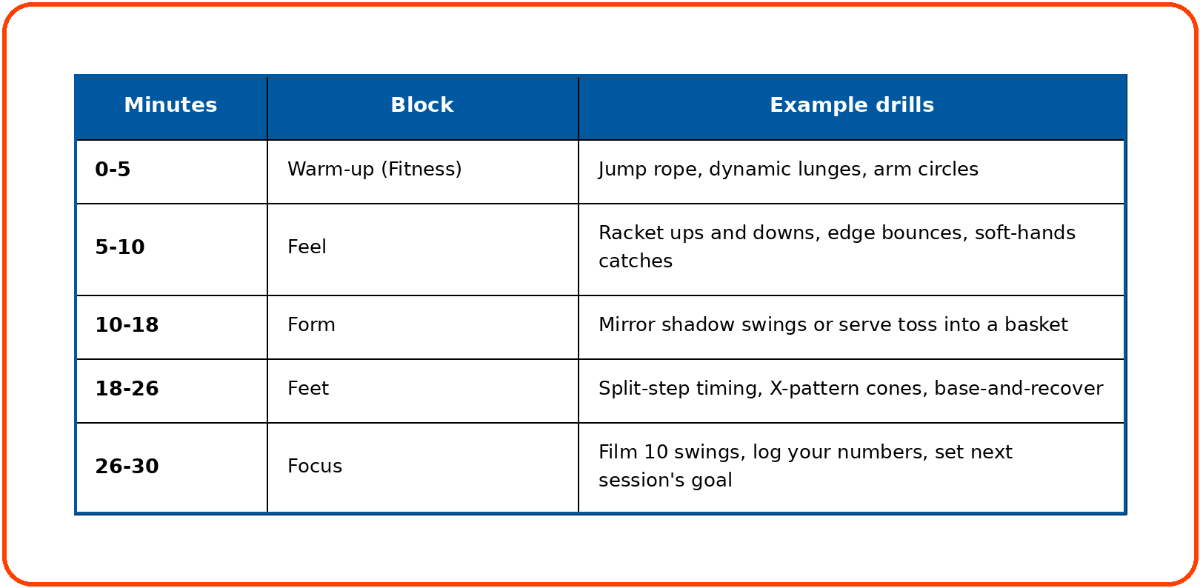
Have a wall? Swap the Form block for wall rallies twice a week.
A realistic weekly schedule for a player with no court access:
- Monday: 30-minute 5F session (technique emphasis)
- Wednesday: Wall session or serve toss plus footwork, 30 to 40 minutes
- Friday: 30-minute 5F session (movement emphasis)
- Weekend: Any real hitting you can get: a partner, a league, a lesson
Three focused half-hours per week is enough to feel a difference on court within a month. Consistency wins here, not marathon sessions.
What Are the Most Common Mistakes in Solo Tennis Practice?
- Hitting too hard against the wall. The ball returns faster than a real rally ball, so power turns practice into chaos. Control first.
- Only practicing strengths. Solo time is the perfect low-pressure setting to fix your weaker wing, not to hit another hundred favorite forehands.
- Skipping footwork. Many players focus only on swings, yet footwork is one of the biggest benefits of home practice.
- Careless repetition. Repetition only helps when it is done with focus. A hundred sloppy shadow swings groove sloppy technique.
- Unsafe surfaces. Grass, uneven tiles, loose gravel or wet concrete make practice unsafe. Reduce speed rather than forcing aggressive movement on a bad surface.
- No measurement. If you never count anything, you cannot know whether you are improving.
How Can Coaches and Clubs Prescribe Tennis Home Practice?
If you coach kids or administer a tennis program, off-court homework is one of the most inexpensive methods to fast-track player development. If a player turns up to a lesson with grooved shadow strokes and automatic split steps, then they are using their lesson time to work on tactics and live hitting, not the foundations.
A simple approach that works for most programs:
- Assign one 5F session per week between lessons, scaled to each player's age and space at home.
- Ask players (or parents, for juniors) to log one number per session, such as longest wall rally or toss accuracy out of ten.
- Review the logs briefly at the next session and adjust.
The operational problem is communication: dependably sending practice plans, videos and reminders to every family, and keeping schedules straight when court time does become available. This is where a sports management platform generates its money. SportsPlus provides tennis clubs, academies and coaches with a single platform to communicate with players and parents, exchange materials, manage schedules and handle program registration, ensuring that at-home training plans reach the families they’re meant for, instead of disappearing in a group chat.
Final Takeaway
You don't need a court to be a better tennis player. You need a plan. Train feel, form, feet, fitness and focus in brief, regulated sessions. Use a wall whenever you can, keep the power down and the repetitions up, and measure one item per session. And when you do get your court time, use it to gain what solitary practice can’t give you: live reads, tactics and competitiveness.
Clubbing a tennis club, academy or junior program? With SportsPlus you can manage registrations, timetables, team communication and player engagement in one platform so your coaching reaches players even while they are training at home. Visit the platform or schedule a demo at sportsplus.app.
Frequently Asked Questions
Can you grow better at tennis without ever setting foot on the court?
You may improve technique, footwork, ball feel and fitness dramatically without a court and those improvements transfer immediately to matches. Live striking is something you can't fully perfect on your own, so incorporate tactical play against the unpredictability of a live opponent whenever you can.
How can I practice tennis alone effectively?
A wall is the best solitary tool. It gets every ball back and never makes a mistake. No wall? Mix shadow swings, serve throw drills, footwork patterns and ball control workouts with the 5F system in this guide.
How to practice tennis in apartment?
Concentrate on mirror shadow swings, grip change drills, foam ball racket handling, split-step timing and core fitness. Painter's tape can be used indoors to indicate positions and can be readily removed.
What equipment do I need to play tennis at home?
You just need a racket and a few balls. You can film with a phone, and the cheap improvements are a mirror, chalk or tape, cones, jump rope. Optional rebounder trainer balls with elastic cords are good for driveways and parks.
Are tennis rebounders and trainer balls worth it?
Ideal for gamers without access to a wall. A trainer rebounder is a base with a tennis ball linked to a string, and the ball rebounds back to you after each hit, allowing you to practice hitting in a driveway, backyard or park.
How can I work on my serve without a court?
Train the toss and the action individually. Basket toss drill: Place a basket 12-18 inches in front of your lead foot and land tosses in the basket and shadow serves in slow motion. Serve full hits at a marked target in an open field.
How hard do I strike the wall?
Softer than it should feel. You cannot hit a wall too hard and be prepared for its return. Start at a 4 or 5 out of 10 in power and only increase if the rallies are under control.
How much should I practice tennis by myself?
For most players, three focused sessions of 30 to 40 minutes per week is a reasonable goal, and it's enough time to witness on-court improvement in roughly a month. Short and frequent beats lengthy and infrequent.
What is shadow swings & does it really work?
Shadow swings are full-stroke motions without the ball, and should be done in front of a mirror, ideally. They allow you to work on the positioning of the wrist and arm, footwork, the movement of the hips and shoulders and weight transfer without the distraction of an approaching ball. They are one of the quickest ways to correct technique.
Tennis drills for kids at home: What are some?
Juniors can focus on racket ball bouncing, drop-feed hitting, wall rallies, serve toss practice, and shadow footwork. As the kid walks to each position, a parent can yell out "forehand," "backhand," "net" or "back" and the kid gets in their stance and swings. This is footwork training with no equipment.
Hitting against a wall is as good as playing with a partner?
The wall is arguably superior for consistency, reflexes, stroke repetition, since it never misses. Tactics, shot selection, controlling varying spins and speeds are priceless with a real partner. Use them both.
How do I know my solitary practice is working?
Remember one number each session, such your longest wall rally or successful tosses out of 10. If the figure goes up over two to three weeks, it is working. If not, slow the drill down and examine technique on video before adding volume.

Nathan Uppara
Digital Marketing Lead at SportsPlus
Nathan Uppara is the Digital Marketing Lead at SportsPlus, where he helps sports organizations discover better ways to manage registration, payments, scheduling, communication, websites, and mobile apps. He combines his experience in digital marketing and sports technology to create practical content and resources for clubs, leagues, and sports organizations.
Latest in Coaching & Parenting

Smarter Sports Management with AI-Powered Features in SportsPlus
Jan 7, 2026184
Why High Schools Need All-In-One Sports Platform. A Guide for Athletic Directors
Oct 29, 2024374
How High Schools Can Leverage SportsPlus to Elevate Student-Athlete Success
Oct 24, 2024231
Why SportsPlus Outshines BigTeams for High School Sports Management
Oct 22, 2024241
How SportsPlus Streamlines Transactions Worldwide
Oct 1, 2024371
Popular in Coaching & Parenting

10 Best Basketball Quotes On Self-Motivation And Teamwork
Dec 14, 202311538
Top 6 Golf Online Stores
Dec 14, 202310923
Top 5 Tennis Online Stores
Dec 14, 20239062
How American sports programs compare to European sports programs.
Jan 16, 20245852
Top 10 Sports Website Builders Compared (Why Most Will Cost You Registrations)
Jun 18, 20241566